
Introduction: Understanding Marble Wastage Before Purchasing Marble for Flooring
Marble flooring is one of the most popular choices for homeowners who want to give their houses an elegant, luxurious and timeless appearance. Whether you are constructing a new home, renovating an existing property, designing a luxury villa or working on a commercial project, selecting the right marble is an important decision. However, one factor that many buyers overlook while purchasing marble is the amount of material that gets wasted during flooring installation.
Marble wastage during flooring is a common concern for homeowners, architects, interior designers, builders and contractors. Many customers calculate their total flooring area and purchase exactly the same quantity of marble, assuming that every square foot or square metre purchased will be used on the floor. In reality, marble needs to be cut, adjusted and arranged according to the dimensions of individual rooms. Corners, doorways, pillars, wall edges, passages, staircases and different room shapes can create leftover pieces that may not be suitable for use in another area. This is why purchasing an appropriate additional quantity of marble is essential before starting flooring work.
A common question among marble buyers is: How much extra marble should I purchase for 1,000 square feet of flooring? Should I buy 5% extra, 10% extra or even 15% extra? Can I reduce marble wastage by choosing standard-sized square marble pieces? How much marble should I purchase in square feet and square metres? The answers depend on the room layout, marble dimensions, flooring pattern, cutting plan and installation method.
Generally, for a straightforward residential flooring project, keeping approximately 5%–10% extra marble is a useful initial estimate. For complicated layouts, diagonal flooring, decorative borders and special patterns, the additional requirement may increase to 10%–15% or more. However, these are planning guidelines rather than fixed wastage standards.
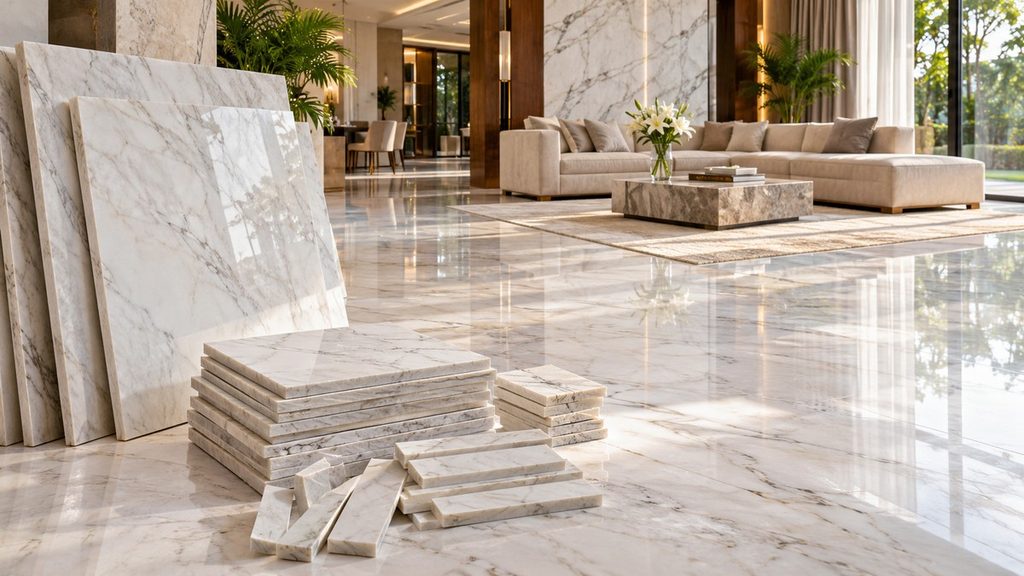
In this detailed guide by Evershine Marbles, we will explain everything a marble buyer should know about marble wastage during flooring, including the correct extra quantity to purchase, calculations in square feet and square metres, practical ways to reduce wastage, the importance of selecting standard dimensions and how proper planning can help save money during construction.
About Evershine Marbles – Marble Manufacturers, Suppliers and Natural Stone Specialists
Evershine Marbles Private Limited is an established name in the Indian natural stone industry, with roots dating back to the 1980s and three generations of experience in the marble business. It was founded by Mr Vinod Kumar Agarwal. With its presence in Makrana, Rajasthan, and operations serving marble buyers through Kishangarh, Evershine Marbles is associated with the mining, manufacturing, processing and supply of natural stones for residential, commercial and architectural projects. Over the years, the company has developed an understanding of the natural stone industry, from marble selection and processing to customer requirements, material dimensions and large-scale supply. Evershine Marbles offers a diverse collection of Indian marble, Makrana Marble, Makrana Plain White Marble, Albeta Marble, Dungri Marble, Kumari Marble, premium imported marble, white marble, grey marble, beige marble and several other natural stone varieties. The collection also includes different types of granite, including South Indian Granite, Rajasthan Granite, black granite, grey granite, pink granite and other natural stone options. Whether customers are looking for elegant white marble for residential flooring, imported marble for luxury interiors, granite for kitchens and commercial spaces or natural stone in bulk quantities for construction projects, Evershine Marbles aims to provide suitable material options at competitive prices.
The company understands that purchasing marble involves more than simply selecting a beautiful stone. Buyers also need to consider the correct quantity, dimensions, cutting requirements, shade consistency, installation patterns and overall project budget. This is why understanding marble wastage and purchasing the right additional quantity is an important part of planning any flooring project. Evershine Marbles serves homeowners, builders, architects, interior designers, contractors, dealers and bulk marble buyers looking for a reliable marble manufacturer in Makrana, marble supplier in Kishangarh, marble dealer in Rajasthan and natural stone supplier in India. With a focus on natural stone selection, manufacturing, processing and customer relationships, Evershine Marbles continues to serve customers looking for quality marble and granite for their homes and commercial developments.
1. What Is Marble Wastage During Flooring?
Marble wastage refers to the portion of purchased marble that cannot be used in the intended flooring area because of cutting, sizing, trimming, breakage, design requirements or unsuitable leftover dimensions.
When marble is installed in a house, the flooring contractor cannot simply place every slab or tile without making adjustments. Each room has different measurements, and marble pieces must be arranged according to the available space.
For example, suppose your living room measures 15 feet × 20 feet. The total flooring area is 300 square feet. If you purchase marble pieces with dimensions that do not fit the room perfectly, some pieces will need to be cut.
The leftover portions may not always be suitable for another room or another part of the floor.
This leftover material is generally referred to as marble cutting wastage.
Marble wastage can happen because of:
- Cutting marble according to room dimensions.
- Trimming edges and adjusting corners.
- Incorrect or unsuitable marble dimensions.
- Pillars and architectural structures.
- Doorways and wall openings.
- Small passages and irregular room shapes.
- Diagonal flooring patterns.
- Decorative borders and designs.
- Natural cracks, damaged edges or breakage.
- Improper measurement and cutting mistakes.
Understanding these factors before purchasing marble can help customers avoid shortages and unnecessary expenses.
2. How Much Marble Wastage Is Normal During Flooring?
One of the most important questions for every marble buyer is how much Marble wastage should be expected during flooring.
The answer depends on the flooring design and the dimensions of the marble being used.
Here is a general estimation of additional marble requirements for different flooring conditions:
| Flooring type or layout | Suggested extra marble |
|---|---|
| Simple rectangular flooring | 5% |
| Regular residential flooring | 5%–10% |
| Standard-sized square pieces | 5%–8% |
| Multiple small rooms | 7%–10% |
| Large-format marble slabs | 5%–10% |
| Diagonal flooring | 10%–15% |
| Decorative border flooring | 10%–15% |
| Complex designs and patterns | 10%–15% or more |
| Bookmatched marble designs | Project-specific calculation |
These percentages are general purchasing estimates. They are not guaranteed wastage rates for every project.
For example, a large rectangular room with standard-sized marble pieces may require less additional material than a house with multiple small rooms, narrow passages, pillars and complicated corners.
Important: Your flooring contractor should prepare a cutting layout before the final marble order. A proper cutting plan can sometimes reduce the additional quantity required.
3. How Much Extra Marble Should You Buy for Flooring?
For most homeowners, purchasing approximately 5%–10% extra marble is a reasonable starting point for regular flooring projects.
Let’s understand this with a simple example.
Suppose your house has a total flooring area of 1,000 square feet.
If you purchase exactly 1,000 square feet of marble, the material may fall short because some pieces will need cutting and adjustment.
If you keep 5% extra:
1,000 × 5% = 50 square feet.
Total marble required = 1,050 square feet.
If you keep 10% extra:
1,000 × 10% = 100 square feet.
Total marble required = 1,100 square feet.
Therefore, depending on the layout, you should consider purchasing approximately 1,050–1,100 square feet of marble.
Marble Wastage Calculation Table in Square Feet
| Actual flooring area | 5% extra | 10% extra | 15% extra |
|---|---|---|---|
| 300 sq. ft. | 315 sq. ft. | 330 sq. ft. | 345 sq. ft. |
| 500 sq. ft. | 525 sq. ft. | 550 sq. ft. | 575 sq. ft. |
| 750 sq. ft. | 787.5 sq. ft. | 825 sq. ft. | 862.5 sq. ft. |
| 1,000 sq. ft. | 1,050 sq. ft. | 1,100 sq. ft. | 1,150 sq. ft. |
| 1,200 sq. ft. | 1,260 sq. ft. | 1,320 sq. ft. | 1,380 sq. ft. |
| 1,500 sq. ft. | 1,575 sq. ft. | 1,650 sq. ft. | 1,725 sq. ft. |
| 2,000 sq. ft. | 2,100 sq. ft. | 2,200 sq. ft. | 2,300 sq. ft. |
| 2,500 sq. ft. | 2,625 sq. ft. | 2,750 sq. ft. | 2,875 sq. ft. |
| 3,000 sq. ft. | 3,150 sq. ft. | 3,300 sq. ft. | 3,450 sq. ft. |
| 5,000 sq. ft. | 5,250 sq. ft. | 5,500 sq. ft. | 5,750 sq. ft. |
This table helps homeowners calculate their additional marble requirements before visiting a marble manufacturer or supplier.
4. How Much Extra Marble Should You Buy in Square Metres?
Many international buyers, architects and construction professionals calculate their flooring requirements in square metres instead of square feet.
Therefore, it is important to understand marble wastage calculations in both measurement units.
Square feet to square metres conversion:
1 square metre = 10.7639 square feet.
1 square foot = 0.092903 square metres.
The same wastage percentage applies whether you calculate in square feet or square metres.
Marble Wastage Calculation Table in Square Metres
| Actual flooring area | 5% extra | 10% extra | 15% extra |
|---|---|---|---|
| 50 sq. m. | 52.5 sq. m. | 55 sq. m. | 57.5 sq. m. |
| 75 sq. m. | 78.75 sq. m. | 82.5 sq. m. | 86.25 sq. m. |
| 100 sq. m. | 105 sq. m. | 110 sq. m. | 115 sq. m. |
| 125 sq. m. | 131.25 sq. m. | 137.5 sq. m. | 143.75 sq. m. |
| 150 sq. m. | 157.5 sq. m. | 165 sq. m. | 172.5 sq. m. |
| 200 sq. m. | 210 sq. m. | 220 sq. m. | 230 sq. m. |
| 250 sq. m. | 262.5 sq. m. | 275 sq. m. | 287.5 sq. m. |
| 300 sq. m. | 315 sq. m. | 330 sq. m. | 345 sq. m. |
| 400 sq. m. | 420 sq. m. | 440 sq. m. | 460 sq. m. |
| 500 sq. m. | 525 sq. m. | 550 sq. m. | 575 sq. m. |
Example: Calculating Marble for a 150 Square Metre House
Suppose your house has 150 square metres of flooring.
You decide to keep 10% extra marble.
- Actual flooring area: 150 square metres.
- Extra material at 10%: 15 square metres.
- Total marble required: 165 square metres.
Therefore, you should plan to purchase approximately 165 square metres of marble, subject to the final cutting layout.
This calculation is especially useful for customers purchasing marble in bulk or working with international measurement standards.
5. How Can You Reduce Marble Wastage During Flooring?
Reducing marble wastage is not just about purchasing extra material. It is also about selecting the correct dimensions, preparing a proper cutting plan and using the available marble efficiently.
A customer can save a considerable amount of money by discussing these factors with the marble supplier and flooring contractor before placing an order.
Here are some of the most effective ways to reduce marble wastage.
A. Select Standardised Square Marble Sizes
One of the simplest ways to reduce marble cutting wastage is to choose standardised square dimensions wherever they suit the flooring layout.
For example, suppose you are using square marble pieces measuring 2 feet × 2 feet.
Each piece covers:
2 × 2 = 4 square feet.
If the room dimensions are multiples of 2 feet, the pieces can often be arranged efficiently with fewer cuts.
Similarly, other square sizes may be suitable depending on the dimensions of the room.
Examples include:
- 1 ft × 1 ft.
- 1.5 ft × 1.5 ft.
- 2 ft × 2 ft.
- 2.5 ft × 2.5 ft.
- 3 ft × 3 ft.
These are illustrative dimensions; actual available sizes depend on the material and processing requirements.
Why are square marble pieces useful?
- They are easier to arrange in a regular grid pattern.
- They can simplify room-wise cutting calculations.
- They may create more reusable offcuts.
- They can make installation planning easier.
- They can reduce unnecessary trimming when room dimensions are compatible.
However, selecting square pieces alone does not guarantee zero wastage. The room dimensions, grout or joint spacing, perimeter cuts and material dimensions must all be considered.
B. Choose Marble Dimensions According to Room Measurements
Before purchasing marble, measure the length and width of every room.
For example:
| Room | Length | Width | Total area |
|---|---|---|---|
| Living room | 20 ft | 15 ft | 300 sq. ft. |
| Bedroom 1 | 15 ft | 12 ft | 180 sq. ft. |
| Bedroom 2 | 14 ft | 12 ft | 168 sq. ft. |
| Dining room | 12 ft | 10 ft | 120 sq. ft. |
| Kitchen | 10 ft | 10 ft | 100 sq. ft. |
| Total | 868 sq. ft. |
Once you have the measurements, ask your flooring contractor to suggest suitable marble dimensions.
Choosing the right size according to the room dimensions can reduce the number of unnecessary cuts.
C. Prepare a Marble Cutting Layout Before Purchasing
A cutting layout is one of the most useful tools for controlling marble wastage.
Instead of randomly cutting marble pieces during installation, the contractor should prepare a layout showing how each marble piece will be positioned.
A proper cutting layout helps identify:
- Where full marble pieces can be installed.
- Where partial pieces will be required.
- How leftover pieces can be reused.
- Which room dimensions create the most cutting waste.
- Whether the selected marble size is suitable.
- How the cutting direction affects natural veins.
For large residential and commercial projects, a room-wise cutting plan can make a significant difference.
D. Use Leftover Pieces in Other Areas
Another effective way to reduce marble wastage is to reuse suitable leftover pieces.
For example, leftover marble from a large living room may be used for:
- Small passages.
- Window sills.
- Door thresholds.
- Bathroom shelves.
- Small utility areas.
- Wall borders.
- Mandir platforms.
- Staircase side sections.
However, leftover pieces should be reused only when their dimensions, appearance and structural suitability are appropriate.
For premium marble with prominent natural veins, the arrangement should also be planned to maintain a consistent appearance.
E. Select Rectangular or Square Layouts Instead of Complicated Patterns
The flooring pattern directly affects the amount of material that needs to be cut.
Regular straight layouts generally allow more efficient use of standard-sized marble pieces.
Diagonal flooring, complex geometric designs and decorative patterns can create additional triangular or irregular offcuts.
If your main priority is reducing marble wastage, discuss a simple straight-line flooring arrangement with your interior designer or contractor.
F. Avoid Unnecessary Changes in Marble Size
Changing marble dimensions from one room to another can increase cutting and leftover material.
For example, if the living room uses one size and every bedroom uses a different size, the cutting plan becomes more complicated.
Where the design allows, maintaining a consistent marble size throughout connected areas can improve material utilisation.
This is particularly useful for homes with multiple bedrooms and long passages.
G. Measure Every Room Properly Before Ordering
Incorrect measurements are one of the most avoidable causes of material shortage and wastage.
Do not calculate the entire house based only on approximate built-up area.
Measure the actual flooring area of each room separately, accounting for wall thickness, shafts, permanent openings and areas that will not receive flooring.
Also include separate measurements for staircases, landings and other special applications.
6. Does the Shape of Marble Pieces Affect Wastage?
Yes. The shape and dimensions of marble pieces can affect the cutting efficiency of a flooring project.
Square and rectangular pieces are generally easier to arrange in regular flooring layouts than irregularly shaped pieces.
Let’s understand the difference.
| Marble shape | Flooring arrangement | Wastage considerations |
|---|---|---|
| Square pieces | Regular grid pattern | Often easier to optimise |
| Rectangular pieces | Straight or staggered pattern | Depends on room proportions |
| Large slabs | Large continuous flooring sections | Perimeter cuts may create large offcuts |
| Diagonal pieces | Angled arrangement | Often creates more triangular offcuts |
| Custom-shaped pieces | Decorative arrangement | Requires specialised cutting |
Why Square Pieces Can Be a Better Choice for Certain Projects
Suppose you have a rectangular room measuring 12 feet × 16 feet.
If you select square marble pieces measuring 2 feet × 2 feet:
- Room length: 16 feet.
- Room width: 12 feet.
- Pieces along the length: 8.
- Pieces along the width: 6.
- Total pieces: 48.
- Area per piece: 4 square feet.
- Total flooring area: 192 square feet.
Since both room dimensions are exact multiples of the selected marble dimensions, the main floor area can be covered without perimeter sizing cuts, assuming the actual finished dimensions and joints are compatible.
This is a good example of how selecting suitable standardised dimensions can improve material utilisation.
However, real projects may still require cutting around doorways, columns, thresholds and other architectural details.
7. How Does Room Size Affect Marble Wastage?
The shape and size of each room have a direct influence on the number of cuts required.
A large rectangular room may have a relatively straightforward flooring layout.
On the other hand, a house with several small rooms, narrow passages, L-shaped spaces and multiple corners may require more adjustments.
Here is a general comparison:
| Room layout | Cutting requirements | Wastage potential |
|---|---|---|
| Large rectangular hall | Relatively simple | Lower |
| Square bedroom | Relatively simple | Lower |
| Small bathroom | Multiple perimeter cuts | Higher |
| Narrow passage | More edge adjustments | Higher |
| L-shaped room | Additional corner cuts | Higher |
| Room with pillars | Special cuts | Higher |
| Curved architectural area | Custom cutting | Higher |
This is why buyers should not calculate additional marble solely by looking at the total square footage of the house.
The layout of the flooring is equally important.
8. Does the Type of Marble Affect Wastage?
Different marble varieties can have different cutting and selection requirements.
For example, plain white marble may be selected for a uniform flooring appearance, while decorative imported marble may require additional attention to natural vein direction and pattern matching.
Some natural stones also have variations in thickness, natural fissures and other characteristics that require inspection before processing.
Here are some considerations for different types of marble.
Makrana White Marble
Makrana White Marble is known for its natural white appearance and is widely selected for residential flooring, temples and premium architectural applications.
When purchasing Makrana Plain White Marble, customers should consider slab dimensions, thickness, shade selection and cutting requirements.
Albeta Marble and Dungri Marble
Albeta Marble and Dungri Marble are among the Indian marble varieties that buyers may consider for different flooring and interior applications.
As with other natural marble, their dimensions and room-wise cutting requirements should be evaluated before placing an order.
Imported Marble
Imported marble is available in different shades, including white, grey and beige.
Decorative varieties such as Panda White and Fantasy Brown may require additional care when planning the arrangement because the direction and continuity of natural veins can influence the final appearance.
Granite Flooring
Granite is another popular natural stone used in residential and commercial projects.
Granite flooring also requires additional material for cutting and adjustments. The correct extra quantity depends on the selected dimensions, room layout and installation pattern.
Important: Marble and granite wastage should be calculated according to the actual cutting plan rather than assuming that one material always has a higher wastage percentage than the other.
9. How Much Money Can You Save by Reducing Marble Wastage?
Reducing marble wastage can directly help control your flooring budget.
Let’s understand this with an example.
Suppose:
- Actual flooring area: 2,000 square feet.
- Marble price: ₹150 per square foot.
- Estimated additional material: 10%.
Your calculation would be:
| Particulars | Quantity or cost |
|---|---|
| Actual flooring area | 2,000 sq. ft. |
| Additional marble at 10% | 200 sq. ft. |
| Total purchase quantity | 2,200 sq. ft. |
| Marble price | ₹150/sq. ft. |
| Total material cost | ₹3,30,000 |
Now suppose your contractor prepares an efficient cutting layout and the additional purchase requirement is reduced to 5%.
| Particulars | Quantity or cost |
|---|---|
| Actual flooring area | 2,000 sq. ft. |
| Additional marble at 5% | 100 sq. ft. |
| Total purchase quantity | 2,100 sq. ft. |
| Marble price | ₹150/sq. ft. |
| Total material cost | ₹3,15,000 |
Potential difference in material purchase cost: ₹15,000.
This example demonstrates the financial importance of accurate measurements and efficient cutting.
However, the difference is a comparison between two purchase estimates, not a guaranteed saving. The final material requirement must be established through the actual cutting plan. Also, leftover material may retain value if it can be used elsewhere.
10. Should You Purchase Extra Marble for Future Repairs?
Yes. Apart from installation wastage, keeping some matching marble for future repairs is a sensible decision.
Natural marble comes from different blocks, and each block can have variations in colour, shade and vein patterns.
If you need replacement material after two or three years, finding exactly the same shade or pattern may be difficult.
This is especially important for:
- Makrana Plain White Marble.
- Premium imported white marble.
- Panda White Marble.
- Fantasy Brown Marble.
- Decorative natural marble.
- Specially selected marble for bookmatched flooring.
You should distinguish between two types of extra material:
1. Installation allowance: Material needed for cutting, trimming and fitting.
2. Maintenance reserve: Suitable leftover pieces intentionally retained for possible future repairs.
The maintenance reserve is not necessarily part of the actual installation wastage.
Keep these pieces safely stored, labelled and protected from damage.
11. How to Calculate Marble Wastage Room by Room
One of the best ways to avoid purchasing the wrong quantity is to calculate the marble requirement separately for each room.
Let’s take an example of a residential property.
| Room | Actual area | Extra at 10% | Purchase estimate |
|---|---|---|---|
| Living room | 400 sq. ft. | 40 sq. ft. | 440 sq. ft. |
| Master bedroom | 250 sq. ft. | 25 sq. ft. | 275 sq. ft. |
| Bedroom 2 | 200 sq. ft. | 20 sq. ft. | 220 sq. ft. |
| Bedroom 3 | 180 sq. ft. | 18 sq. ft. | 198 sq. ft. |
| Dining area | 180 sq. ft. | 18 sq. ft. | 198 sq. ft. |
| Kitchen | 120 sq. ft. | 12 sq. ft. | 132 sq. ft. |
| Passage | 150 sq. ft. | 15 sq. ft. | 165 sq. ft. |
| Total | 1,480 sq. ft. | 148 sq. ft. | 1,628 sq. ft. |
This gives you an initial purchase estimate of 1,628 square feet.
However, this calculation assumes that the same marble variety and dimensions are used throughout. If different marble varieties are used in different rooms, calculate each variety separately.
The final requirement should be checked against a combined cutting plan so that suitable offcuts from one area can be reused in another.
12. Important Mistakes to Avoid When Purchasing Marble for Flooring
Many homeowners make simple mistakes while ordering marble, which can lead to unnecessary expenses or material shortages.
Here are some common mistakes to avoid.
- Purchasing exactly the measured flooring area: This may leave insufficient material for cutting and adjustments.
- Not measuring rooms separately: Approximate measurements can result in incorrect orders.
- Ignoring marble dimensions: The selected size should be compatible with the room layout.
- Not discussing the cutting pattern: A cutting plan can help reduce avoidable wastage.
- Choosing complicated designs without considering material requirements: Diagonal and decorative patterns may require additional material.
- Not purchasing extra material from the same selection: Additional material purchased later may have different natural shade or patterns.
- Mixing different marble varieties in the same calculation: Calculate each variety separately.
- Ignoring staircases and special areas: Stair treads, risers, landings and skirting need separate calculations.
- Not checking the material before cutting: Natural cracks, defects and unsuitable edges should be identified before processing.
- Not keeping leftover pieces: Suitable leftovers can be valuable for future repairs.
13. What Should You Ask Your Marble Supplier Before Placing an Order?
Before purchasing marble for your home, ask your marble supplier a few important questions.
These questions can help you understand the quantity, dimensions and suitability of the material.
- What are the available marble dimensions?
- Can the marble be supplied in standardised square or rectangular sizes?
- What is the available thickness?
- Can the selected pieces be cut according to my room measurements?
- Can you help coordinate the material dimensions with the flooring contractor?
- Are the selected pieces from the same block or consistent selection?
- How much additional material should I plan for?
- Can suitable leftover pieces be reused in another room?
- Is the marble suitable for my intended flooring application?
- Can I purchase matching extra material along with the main order?
A good marble purchase begins with accurate information, not simply with selecting the lowest price.
14. Marble Wastage During Flooring: A Quick Buyer Checklist
Before finalising your marble purchase, use this checklist:
- Measure the actual flooring area of every room.
- Calculate the total area in square feet or square metres.
- Decide which marble variety will be used in each room.
- Finalise the marble dimensions and thickness.
- Check whether square or rectangular standard sizes suit the layout.
- Discuss straight or diagonal flooring patterns.
- Prepare a room-wise cutting layout.
- Estimate the additional material requirement.
- Check whether suitable offcuts can be reused.
- Purchase appropriate extra marble from the same selection.
- Keep suitable leftover pieces for future repairs.
Following this checklist can help homeowners, architects and contractors make better purchasing decisions.
15. Frequently Asked Questions About Marble Wastage During Flooring
Q1. How much marble wastage should I consider during flooring?
For regular residential flooring, approximately 5%–10% additional material is a useful starting estimate. Complex layouts and decorative patterns may require 10%–15% or more.
Q2. How much extra marble should I buy for 1,000 square feet of flooring?
For 1,000 square feet of flooring, consider approximately 1,050–1,100 square feet of marble for a regular layout. The final requirement depends on the cutting plan.
Q3. How much extra marble is required for 100 square metres of flooring?
For 100 square metres of flooring, a 5% allowance means 105 square metres, while a 10% allowance means 110 square metres.
Q4. Can I reduce marble wastage by buying square-sized marble pieces?
Yes, square-sized marble pieces can help improve material utilisation when their dimensions match the room layout. They can reduce unnecessary perimeter cutting and make installation planning easier. However, square pieces do not eliminate wastage entirely.
Q5. Is 5% marble wastage enough for a house?
It may be enough for a simple rectangular layout with efficient cutting. However, for multiple rooms, irregular corners and complicated flooring designs, 5% may not be sufficient.
Q6. Does diagonal marble flooring increase wastage?
Generally, yes. Diagonal flooring requires more angled cuts, which can create triangular offcuts and increase material requirements.
Q7. Is marble wastage the same as granite wastage?
Not necessarily in every project, but both materials require additional quantities for cutting and installation. Their wastage depends on dimensions, layout and design.
Q8. Should I buy extra marble from the same block?
Where possible, buying the required additional material from the same block or consistent selection can help maintain shade and pattern consistency.
Q9. Can marble wastage be reused?
Yes. Suitable leftover pieces can be used for window sills, thresholds, shelves, borders, small platforms and other applications, provided their dimensions and condition are appropriate.
Q10. How can I calculate marble wastage in square feet?
Use this formula:
Extra marble = Actual flooring area × Wastage percentage.
For example, 1,500 square feet × 10% = 150 square feet extra marble.
Total purchase quantity = 1,650 square feet.
Q11. How can I calculate marble wastage in square metres?
Use the same formula.
For example, 150 square metres × 10% = 15 square metres extra marble.
Total purchase quantity = 165 square metres.
Q12. Does buying larger marble slabs reduce wastage?
Not always. Larger slabs can reduce joints and improve the appearance of flooring, but their dimensions must be compatible with the room layout. A proper cutting plan is essential.
Q13. Is marble wastage included in the flooring contractor’s quotation?
It depends on the contractor’s quotation. Some contractors quote installation charges separately from material wastage, while others may include certain cutting or handling allowances. Always clarify whether the quotation covers installation, cutting, breakage and leftover material.
Conclusion: Smart Marble Selection and Proper Planning Can Reduce Flooring Wastage
Marble wastage is an important factor that every homeowner should consider before purchasing marble for flooring. Even when you know the exact square footage of your house, the final material requirement can be higher because of cutting, trimming, room dimensions, pillars, corners and flooring patterns.
For regular flooring projects, approximately 5%–10% additional marble is a useful initial planning estimate. However, the correct quantity should always be calculated after reviewing the actual room measurements and cutting layout.
One of the most effective ways to reduce marble wastage is to choose suitable standardised square or rectangular dimensions, plan the flooring pattern in advance, use leftover pieces wherever possible and avoid unnecessary cutting. Buying the correct marble dimensions according to the room layout can help reduce material loss and improve overall project efficiency.
Whether you are purchasing Makrana White Marble, Albeta Marble, Dungri Marble, imported white marble, Fantasy Brown Marble, Panda White Marble or granite, proper quantity planning can help you control your flooring budget and avoid installation delays.
Remember, the objective should not simply be to purchase the least possible extra marble. It should be to purchase the correct quantity, minimise avoidable wastage and retain suitable matching material for future maintenance.
Looking for the Right Marble for Your Flooring Project?
At Evershine Marbles, we understand the importance of selecting the right natural stone, dimensions and quantity for every flooring project. With roots in Makrana, Rajasthan, and experience in the marble mining, manufacturing, processing and supply industry, we offer a diverse collection of Indian marble, Makrana Marble, imported marble, white marble and granite for residential and commercial applications.
Whether you are a homeowner planning marble flooring, an architect selecting natural stones for a luxury villa, a builder managing a large construction project or a dealer looking for a reliable marble supplier, Evershine Marbles can help you explore suitable natural stone options.
Explore our collection of:
- Makrana Plain White Marble.
- Albeta Marble.
- Dungri Marble.
- Kumari Marble.
- Indian White Marble.
- Imported White, Grey and Beige Marble.
- Fantasy Brown Marble.
- Panda White Marble.
- South Indian Granite.
- Rajasthan Granite.
- Black, Grey and Pink Granite.
Visit Evershine Marbles: https://evershinemarble.co.in/
Explore our marble and granite collection and get in touch with our team to discuss your natural stone requirements.
Evershine Marbles – Your Destination for Marble, Granite and Natural Stone in India.