
Marble flooring has always been associated with elegance, durability and timeless beauty. From traditional Indian homes to luxury villas, hotels, offices and commercial buildings, marble remains one of the most preferred flooring materials in India.
But when planning a marble floor, the price of the marble itself is only one part of the total cost.
The actual marble flooring cost in India depends on several factors, including the type of marble, quality, thickness, cutting, polishing, transportation, installation charges and, importantly, the amount of wastage generated during the project.
Indian marble and imported marble can have a significant difference in their overall flooring cost. Imported marble generally has a higher material price, higher fitting charges and can also generate more wastage because of natural cracks, irregular slab dimensions and the need for better selection and matching.
This guide explains the major factors that determine the cost of marble flooring in India, so you can estimate your project budget more realistically.

What Is the Cost of Marble Flooring in India?
There is no single fixed price for marble flooring in India because marble is available in hundreds of varieties and qualities.
The first question is:
Are you planning to use Indian marble or imported marble?
The approximate material price can range from:
| Type of Marble | Approximate Price Range |
|---|---|
| Indian Marble | ₹20 – ₹2,000+ per sq. ft. |
| Imported Marble | ₹200 – ₹10,000+ per sq. ft. |
These are broad market ranges. The actual price depends on the variety, colour, pattern, origin, quality, thickness, availability and selection.
In general, Indian marble is more economical than imported marble, although premium Indian marbles can also reach very high prices.
Imported marble, particularly premium Italian, Turkish, Spanish and other international varieties, can command significantly higher prices because of rarity, appearance, quarrying conditions, processing, transportation and import-related costs.

Marble Flooring Cost Depends on More Than the Marble Price
When people calculate flooring costs, they often look only at the price per square foot of the marble.
For example, if a marble costs ₹500 per sq. ft., it may appear that flooring 1,000 sq. ft. will cost ₹5 lakh.
But this is not the complete calculation.
The final cost may include:
- Marble material
- Selection and sorting
- Cutting
- Edge cutting
- Polishing
- Transportation
- Loading and unloading
- Wastage
- Laying and fitting
- Cement, adhesive or other installation materials
- Levelling
- Joint filling
- Final polishing
- Sealing or treatment, where required
Therefore, the actual installed cost of marble flooring can be considerably different from the basic marble purchase price.
Indian Marble vs Imported Marble: Which Is More Cost-Effective?
One of the biggest decisions in a marble flooring project is choosing between Indian and imported marble.
Both have their own advantages.
Indian marble is generally preferred when the objective is to achieve a beautiful natural-stone floor at a comparatively economical price.
Imported marble is often selected when the project requires a particular colour, pattern, background or luxury appearance that may not be easily available in Indian marble.
Indian Marble
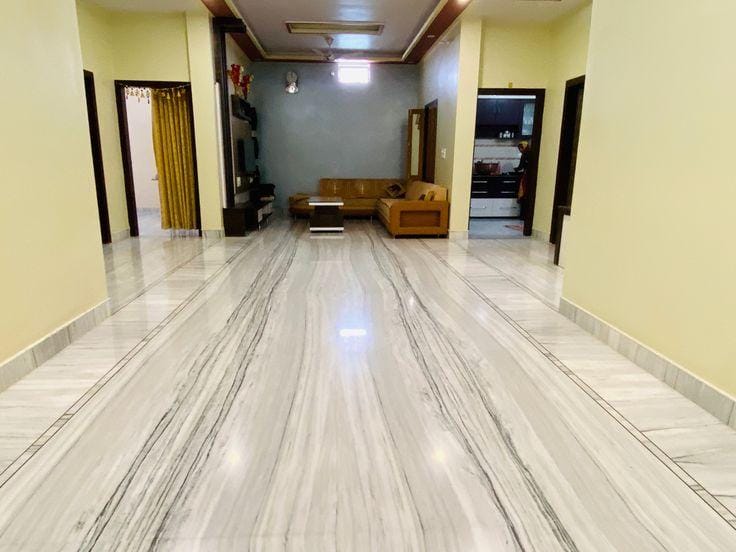
Indian marble is available in a wide variety of colours, patterns and finishes.
Depending on the variety, Indian marble can be used for:
- Residential flooring
- Staircases
- Hotels
- Temples
- Commercial buildings
- Wall cladding
- Bathrooms
- Elevation work
- Decorative applications
One major advantage is that many Indian marble varieties are available at comparatively lower prices.
Imported Marble
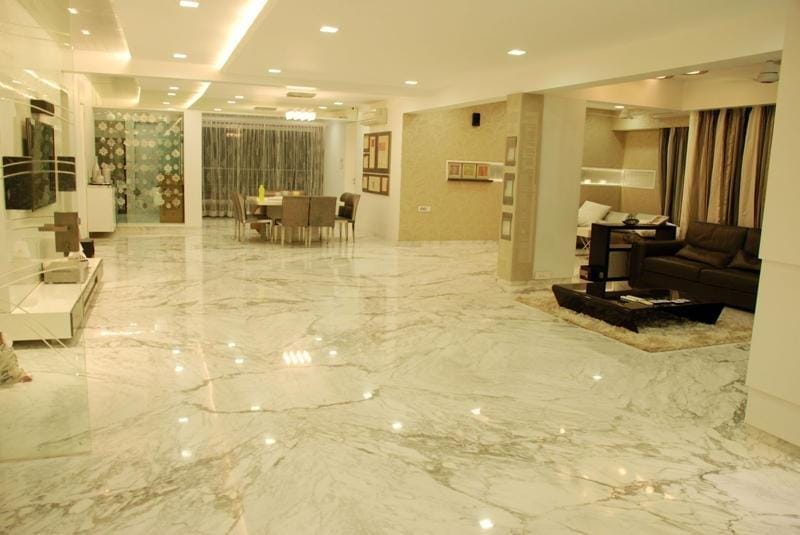
Imported marble offers a wide range of distinctive patterns and colours. Materials from Italy, Turkey, Spain, Vietnam and other countries are widely used in premium residential and commercial projects.
Imported marble is particularly popular for:
- Luxury residences
- Premium villas
- Hotels
- High-end commercial interiors
- Feature walls
- Large-format flooring
- Bookmatched installations
However, the overall project cost can be higher—not only because of the material price but also because of cutting, handling, selection, matching, wastage and installation.
Indian Marble vs Imported Marble Flooring Cost
| Factor | Indian Marble | Imported Marble |
|---|---|---|
| Material Cost | Generally lower | Generally higher |
| Variety | Very wide | Very wide |
| Cutting Cost | Usually lower | Usually higher |
| Installation/Fitting | Comparatively economical | Usually higher |
| Wastage | Generally lower | Can be higher |
| Crack/Variation Risk | Depends on variety | Depends on variety; some materials need more careful selection |
| Matching | Usually easier | Can require careful slab selection |
| Handling | Comparatively easier | Often requires greater care |
| Overall Project Cost | Generally economical | Generally higher |
The important point is that the cheapest marble per sq. ft. is not always the cheapest flooring solution.
The complete installed cost should be considered.
Marble Wastage: One of the Most Important Cost Factors
Wastage is often overlooked when calculating marble flooring costs.
Suppose you have a 1,000 sq. ft. flooring area. You cannot always purchase exactly 1,000 sq. ft. of marble and expect all of it to be usable.
Marble needs to be cut according to the actual dimensions of the rooms.
There may be:
- Cutting around columns
- Door openings
- Corners
- Staircases
- Pillars
- Curved areas
- Uneven walls
- Bathroom or kitchen edges
- Pattern matching
- Vein matching
- Cracks or natural defects
Therefore, some additional material normally needs to be purchased.
Why Can Imported Marble Have More Wastage?
Imported marble can sometimes produce higher wastage than Indian marble, particularly when the design requires careful vein matching or when slabs have natural cracks, variations or irregular usable portions.
Another important consideration is that imported marble slabs may not always provide a perfectly uniform square or rectangular usable area after accounting for natural edges, cracks and other characteristics.
For premium imported marble, the usable area should therefore be considered carefully rather than simply multiplying the nominal slab dimensions.
How Much Marble Wastage Should You Consider?
There is no universal wastage percentage because every project is different.
A simple rectangular room with straightforward installation may have relatively low wastage.
A project with:
- Multiple rooms
- Complicated layouts
- Curved areas
- Many columns
- Large veins
- Bookmatching
- Specific pattern matching
- Premium imported marble
can require considerably more planning and additional material.
As a broad planning approach, buyers may commonly consider approximately 5%–10% additional material for relatively straightforward flooring, while complex projects can require more.
The exact requirement should be calculated after looking at the actual slab sizes and the flooring layout.
For expensive imported marble, even a small increase in wastage can significantly increase the total project cost.
Example: How Wastage Changes Your Marble Flooring Budget
Suppose your flooring area is:
1,000 sq. ft.
And the marble price is:
₹800 per sq. ft.
Without wastage:
1,000 × ₹800 = ₹8,00,000
Now suppose 8% additional material is required.
Required material:
1,000 + 80 = 1,080 sq. ft.
Material cost:
1,080 × ₹800 = ₹8,64,000
The difference is:
₹64,000
This example shows why wastage should be included while preparing a marble flooring budget.
And if the marble costs ₹3,000 or ₹5,000 per sq. ft., the financial impact of wastage becomes much more significant.
Cutting Charges for Marble Flooring
Marble cutting is another component of the final flooring cost.
The marble may need to be cut according to the actual floor layout before installation.
Cutting requirements can vary depending on:
- Marble thickness
- Slab size
- Cutting method
- Number of pieces
- Design
- Straight or angled cuts
- Border design
- Pattern matching
- Bookmatching
- Project complexity
Simple straight cuts generally require less work than complicated designs or premium marble layouts.
For imported marble, cutting and handling can require additional care because the material may be expensive and natural variations or cracks need to be considered during processing.
Marble Fitting and Installation Charges
The fitting charge is another important part of the total marble flooring cost.
Installation involves much more than simply placing marble on the floor.
Depending on the project, the process may include:
- Preparing the floor
- Checking levels
- Planning the marble layout
- Cutting the pieces
- Applying the bedding material or adhesive
- Placing the marble
- Maintaining the required joints
- Levelling the pieces
- Filling joints
- Grinding and polishing
- Final cleaning
The fitting cost depends on the type of marble and complexity of the work.
In general, imported marble flooring can have higher fitting charges than standard Indian marble flooring because the material may require more careful handling, layout planning, cutting and matching.
Premium marble should ideally be installed by experienced professionals who understand the material.
Why Proper Measurement Is Important
Correct measurement can save a significant amount of money.
Before purchasing marble, the actual site should be measured carefully.
Simply calculating:
Length × Width = Flooring Area
is not always enough for a complete project.
The layout should also consider:
- Room dimensions
- Slab dimensions
- Direction of veins
- Starting points
- Door openings
- Columns
- Staircases
- Borders
- Pattern continuity
- Bookmatching requirements
A professional marble supplier can prepare a cutting and layout plan that helps reduce unnecessary wastage.
Bookmatching Can Increase Marble Consumption
Bookmatching is one of the most attractive ways of using highly veined marble.
Two or more slabs are placed next to each other so that the veins create a mirror-like pattern.
This can create a stunning visual effect in:
- Living rooms
- Hotel lobbies
- Feature walls
- Reception areas
- Luxury bedrooms
- Large entrance areas
However, bookmatching requires careful slab selection.
Not every part of a slab can necessarily be used just because it has the required colour. The veins also need to align with the design.
Therefore, bookmatched marble can result in higher material consumption and wastage, particularly when expensive imported marble is being used.
How to Calculate the Approximate Cost of Marble Flooring
A simple way to estimate your total budget is:
Total Marble Flooring Cost = Material Cost + Wastage + Cutting + Installation + Other Charges
For example:
| Cost Component | Example |
|---|---|
| Flooring Area | 1,000 sq. ft. |
| Marble Rate | ₹500/sq. ft. |
| Basic Material Cost | ₹5,00,000 |
| Additional Material for Wastage | Depends on layout |
| Cutting | Depends on work |
| Fitting | Depends on marble and site |
| Polishing | Depends on finish and project |
| Transportation | Depends on distance |
| Final Cost | Depends on the complete project |
This is why a marble quotation should ideally be prepared after understanding the marble variety, required quantity, slab dimensions and actual site requirements.
Factors That Can Increase Marble Flooring Cost
Several factors can increase the final cost of a marble flooring project.
Premium Marble Selection
Rare and premium-quality marble naturally costs more.
Imported Marble
Imported marble generally has higher material and handling costs.
Higher Wastage
Complex layouts and natural cracks can increase the quantity required.
Bookmatching
Mirror-pattern installation requires carefully selected slabs.
Complex Cutting
Borders, curves, angles and custom designs increase processing requirements.
Difficult Site Conditions
Higher floors, limited access and difficult transportation can increase labour and handling costs.
Premium Finishing
Additional grinding, polishing and finishing requirements can increase the final cost.
Long-Distance Transportation
Transportation costs vary according to the source of the marble and project location.
How to Reduce Marble Flooring Cost Without Compromising Quality
A good marble floor does not necessarily require choosing the most expensive marble.
You can control the project budget by planning carefully.
Choose the Right Marble
Select a marble according to your project requirements rather than choosing only on appearance.
Plan the Layout Before Cutting
Proper planning can significantly reduce unnecessary cutting and wastage.
Purchase the Correct Quantity
Buying too little can create matching problems later, while excessive purchasing can increase unnecessary inventory.
Consider Locally Available Options
If a suitable Indian marble is available for the desired appearance, it may provide a more economical alternative to imported marble.
Work With an Experienced Supplier
An experienced supplier can help with:
- Material selection
- Quantity calculation
- Slab selection
- Layout planning
- Cutting
- Matching
- Transportation
- Installation coordination
This can help control the overall cost of the project.
Is Indian Marble Better Than Imported Marble?
There is no universal answer.
The right marble depends on your project.
If your priority is:
- Cost efficiency
- Good availability
- Natural appearance
- A wide selection of Indian stones
then Indian marble can be an excellent choice.
If your priority is:
- Specific colours
- Unique veins
- Luxury appearance
- Rare patterns
- International marble varieties
then imported marble may be more suitable.
The important thing is to compare the complete installed cost, rather than only the purchase price per sq. ft.
Is Expensive Marble Worth It for Flooring?
Premium marble can be worth the investment when the visual appearance is an important part of the project.
Luxury marble can create a completely different atmosphere in a space.
However, the decision should consider:
Material price + wastage + cutting + installation + maintenance
For a high-value imported marble, wastage alone can represent a significant amount of money.
Therefore, professional selection and proper planning become especially important when using expensive marble.
Marble Flooring Cost: Indian vs Imported — Quick Comparison
| Feature | Indian Marble | Imported Marble |
|---|---|---|
| Starting Price | Generally lower | Generally higher |
| Premium Options | Available | Extensive |
| Wastage | Usually comparatively lower | Can be comparatively higher |
| Cutting | Usually economical | Can cost more |
| Fitting | Usually lower | Usually higher |
| Design Options | Excellent | Excellent |
| Luxury Appearance | Variety available | Many premium options |
| Budget Projects | Very suitable | Less suitable in many cases |
| Premium Projects | Suitable | Highly suitable |
What Should You Ask Your Marble Supplier Before Buying?
Before finalising your marble, ask the supplier about:
- Marble origin
- Grade and quality
- Available thickness
- Slab dimensions
- Price per sq. ft.
- Actual usable area
- Expected wastage
- Cutting charges
- Polishing charges
- Fitting charges
- Transportation
- Loading and unloading
- Availability of additional matching material
- Replacement policy for damaged material
- Installation requirements
These questions can prevent unexpected costs later.
Frequently Asked Questions About Marble Flooring Cost in India
What is the average marble flooring cost in India?
The cost varies significantly according to the marble. Indian marble can broadly range from around ₹20 to ₹2,000+ per sq. ft., while imported marble can range from around ₹200 to ₹10,000+ per sq. ft. Installation, cutting, polishing, transportation and wastage are additional factors.
Is Indian marble cheaper than imported marble?
Generally, yes. Indian marble is usually more economical than imported marble, although premium Indian marble can also be expensive.
Does imported marble have more wastage?
It can. Imported marble may require more careful selection, cutting and matching, and certain materials may have natural cracks, irregularities or vein-matching requirements that increase wastage.
How much extra marble should I buy?
For straightforward projects, a preliminary allowance of around 5%–10% may be considered, but the actual requirement depends on the room layout, slab dimensions, marble characteristics and design.
Are fitting charges higher for imported marble?
Generally, imported marble can have higher fitting and handling charges because of the higher value of the material and the additional care that may be required during cutting, transportation, layout and installation.
Is marble flooring expensive?
It can be economical or extremely premium depending on the marble selected. The wide price range means there are marble options for different project budgets.
Does marble thickness affect the cost?
Yes. Thickness can affect material pricing, transportation, handling, cutting and installation requirements. The appropriate thickness should be selected according to the application and project requirements.
Can wastage be reduced?
Yes. Proper site measurement, slab selection, cutting plans, layout planning and experienced installation can help reduce unnecessary wastage.
Final Thoughts: Calculate the Complete Marble Flooring Cost
The cost of marble flooring in India should never be calculated only by looking at the marble’s price per square foot.
A more accurate calculation considers:
Marble price + wastage + cutting + fitting + polishing + transportation + other installation costs.
Indian marble is generally more economical and can offer lower wastage and fitting costs in many projects. Imported marble, on the other hand, offers an enormous range of premium colours and patterns but can require a larger budget because of material pricing, handling, cutting, matching and wastage.
The best approach is to select the marble according to your budget, design requirements, floor layout and long-term expectations.
A properly planned marble project can help you achieve a premium-looking floor while keeping unnecessary wastage and additional costs under control.
Looking for Quality Marble for Your Project?
If you are planning a residential, commercial, hotel or luxury interior project, selecting the right marble supplier is just as important as selecting the marble itself.
Evershine Marbles offers a wide range of Indian marble, imported marble, granite and natural stones for different types of projects. From material selection and slab inspection to quantity planning and supply, working with an experienced marble supplier can make the entire process easier.
Whether you are looking for Indian marble, Makrana marble, white marble, imported marble or premium natural stone, discuss your project requirements with the Evershine Marbles team before finalising your material.
Contact Evershine Marbles today to explore marble options, compare qualities and get the right material for your flooring project.