
When buying marble slabs, most customers focus on colour, pattern, finish, origin and price. However, marble slab thickness is equally important. The thickness of a marble slab can affect its weight, strength, handling, fabrication, edge profile, installation method and suitability for a particular project.
Marble slabs are available in different thicknesses, including 15mm, 18mm, 20mm, 30mm, 40mm and even thicker custom sizes. There is no single thickness that is suitable for every project or every market.
At Evershine Marbles, we understand that the required thickness is often decided by a combination of the destination market, country requirements, project specifications, application, fabrication requirements and buyer preference.
In international marble trade, different markets may request different thicknesses. For example, one buyer may require 15mm or 18mm slabs, another may specify 20mm, while a particular project may require 30mm or 40mm material. Exporters therefore need to confirm the buyer’s exact specification before processing and packing the material.
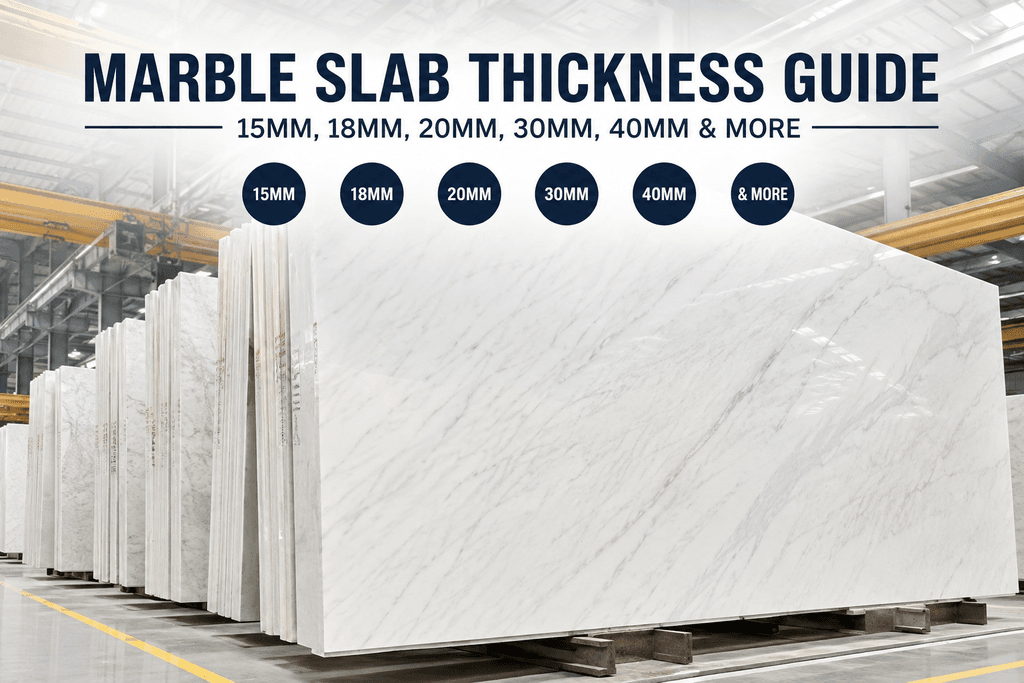
What Does Marble Thickness Guide Mean?
Marble slab thickness refers to the distance from the front polished or finished surface to the back surface of the slab.
For example:
- 15mm = 1.5 cm
- 18mm = 1.8 cm
- 20mm = 2 cm
- 30mm = 3 cm
- 40mm = 4 cm
- 50mm = 5 cm
- 60mm = 6 cm
The thickness is normally specified in millimetres because even a small difference can matter during fabrication, installation and international shipping.
It is also important to understand that a stated thickness can have a manufacturing tolerance. Therefore, buyers should not rely only on the nominal thickness written on an invoice or packing list. The actual slab should be measured.
Why Is Marble Thickness Guide Important?
Choosing the correct thickness is important for several reasons.
1. Strength and Durability
A thicker marble slab can provide greater resistance to bending and breakage when the application and support conditions require it. However, thickness alone does not determine whether a stone is suitable for a particular application. Stone type, slab dimensions, support, fixing method and installation conditions also matter.
2. Weight
A 30mm slab naturally weighs considerably more than an 18mm slab of the same surface area.
This affects:
- Transportation
- Loading and unloading
- Handling
- Installation
- Structural support
- Project logistics
For large-format marble, weight can become an important consideration.
3. Cost
Thickness can influence material cost because producing thicker slabs may require different processing and more raw material.
For this reason, a buyer should not automatically assume that the thickest slab is the best option.
4. Edge Appearance
Thickness also changes the appearance of the finished edge.
An 18mm marble countertop will have a relatively slim edge, while 30mm or 40mm material can provide a more substantial appearance.
Fabricators can also create built-up or laminated edges, so the visual thickness of the finished product does not always have to equal the actual slab thickness.
5. Export Requirements
For exporters and international buyers, thickness is especially important.
The required thickness can depend on the destination country, local market practice, importer specification, project requirement and fabrication method.
Historical Indian trade records, for example, show marble shipments in 15mm, 18mm and 20mm specifications, demonstrating that different thickness specifications have been used in export markets.
Marble Slab Thickness: 15mm, 18mm, 20mm, 30mm and 40mm
15mm Marble Slabs
15mm marble slabs are a relatively thin slab specification and may be selected when weight reduction and the destination market’s requirements are important.
15mm material can be considered for applications where the project design and supporting system are appropriate.
It may be used for:
- Wall applications
- Decorative panels
- Selected flooring applications
- Cut-to-size work
- Interior applications
- Export markets that specifically request 15mm
The important point is that 15mm should not be selected simply because it is thinner or cheaper. The project and installation conditions must be suitable.
Historical export records from India include marble slabs specifically described as 15mm, showing that this thickness has been used in international trade.
18mm Marble Slabs
18mm is one of the important thickness specifications in the marble industry, particularly for processed and export marble.
Many marble slabs are supplied around 18mm, depending on the stone, processing method and market.
18mm marble may be suitable for:
- Residential flooring
- Wall applications
- Interior projects
- Vanity applications with appropriate support
- Commercial interiors
- Export orders
- Cut-to-size marble
Current trade data also contains multiple examples of polished marble slabs specified at 18mm, demonstrating that this is an established international specification.
For buyers ordering 18mm marble, it is advisable to clearly specify the required tolerance in the purchase order.
20mm Marble Slabs
20mm marble is another major international slab specification.
20mm is equivalent to 2 centimetres and is commonly requested for projects where a slightly more substantial slab is required.
Potential applications include:
- Flooring
- Countertops
- Kitchen platforms
- Vanities
- Commercial interiors
- Hotel projects
- Premium residential projects
- Large-format applications with appropriate support
Trade records show 20mm marble slabs being exported to multiple international destinations, confirming the widespread use of this specification.
For many applications, 20mm provides a practical balance between weight, handling and slab thickness.
30mm Marble Slabs
30mm marble means the slab is approximately 3cm thick.
This is considerably thicker than standard 18mm or 20mm material and is generally selected when the project specifically requires a heavier slab or a particular finished edge.
Possible applications include:
- Premium countertops
- Furniture tops
- Staircases
- Window sills
- Heavy-duty applications
- Special architectural projects
- Decorative architectural elements
- Projects requiring a substantial edge appearance
30mm material can be significantly heavier, so transportation, support and installation must be planned accordingly.
It is also important to remember that 30mm should not automatically be considered better than 18mm or 20mm. The correct thickness depends on the application.
40mm Marble Slabs
40mm marble is a specialised thickness compared with the more common 18mm and 20mm specifications.
It can be selected for:
- Heavy furniture tops
- Special countertops
- Staircases
- Architectural elements
- Thick edge profiles
- Special design requirements
- Custom projects
In many cases, 40mm marble is made or supplied specifically according to project requirements rather than being the default thickness for ordinary slab production.
Because 40mm marble is heavier, logistics and structural support become even more important.
What About 50mm, 60mm and Thicker Marble?
Some projects require marble thicker than 40mm.
Depending on the stone and processing facility, special thicknesses such as:
- 50mm
- 60mm
- 80mm
- Custom thicknesses
may be produced for specific requirements.
These thicker sections are generally associated with specialised applications rather than standard flooring slabs.
For example, architectural furniture, monumental work, staircases, carved elements and special design projects may require substantially thicker stone.
Does Every Country Use the Same Marble Thickness?
No. This is one of the most important points for marble exporters and international buyers.
There is no single global thickness that every country or every buyer accepts.
The required thickness can vary according to:
- Destination country
- Local construction practices
- Importer requirements
- Project specifications
- Fabricator requirements
- Building regulations
- Installation system
- Type of marble
- Slab size
- Intended application
For example, a buyer in one market may request 15mm, another may request 18mm, while another buyer may specifically require 20mm.
Similarly, a special project may request 30mm or 40mm.
Therefore, an exporter should never assume that a particular thickness is universally accepted.
Country-Wise Thickness: Why You Should Confirm Before Production
A common mistake in international marble trading is to process the material first and ask about the required thickness later.
The correct approach is the opposite.
Before production, the buyer and exporter should confirm:
Country → Project → Application → Required Thickness → Tolerance → Finish → Size → Packing
For example, if a customer asks for marble slabs for a project in another country, the exporter should confirm the exact thickness required by that buyer rather than automatically supplying the thickness normally sold in India.
International trade records demonstrate that different thickness specifications such as 15mm, 18mm and 20mm occur across marble shipments and markets.
This is why experienced marble exporters generally ask for the buyer’s technical specification before final production.
How Is Marble Slab Thickness Decided?
There are several factors involved.
1. Destination Market
The first consideration for export orders can be the requirement of the destination market.
A market may commonly purchase 18mm marble, while another buyer may prefer 20mm.
2. Application
The same marble can require different thicknesses depending on where it will be installed.
A wall panel and a countertop do not necessarily have the same technical requirements.
3. Slab Size
Larger slabs can create different handling and structural considerations than smaller pieces.
4. Support System
A properly supported marble installation can have different requirements from a piece with a long unsupported span.
5. Marble Type
Different stones can have different physical characteristics. The final specification should therefore consider the actual stone being used.
6. Fabrication
Cut-outs, edge profiles, sink openings, corners and other fabrication details can influence the appropriate thickness.
7. Customer Specification
For export projects, the customer’s purchase order should clearly mention the required thickness and tolerance.
How to Check Marble Slab Thickness?
One of the simplest ways to verify marble slab thickness is to measure the edge of the slab using a suitable measuring instrument.
A vernier caliper can be used for precise measurement of the thickness of an accessible slab edge.
For example, if a slab is sold as 20mm, the measurement should be checked against the agreed specification and tolerance.
Basic checking process:
- Take the slab or an accessible edge.
- Clean the measurement area if necessary.
- Place the jaws of the vernier caliper against the slab.
- Make sure the jaws are properly aligned with the two surfaces.
- Take the reading.
- Check multiple points if required.
- Compare the measured value with the agreed specification and tolerance.
For commercial and export orders, checking more than one point can provide a better understanding of thickness consistency.
Important: Do not confuse a vernier caliper with a “vernier” as a general name for any measuring device. The appropriate instrument should be selected according to the required accuracy and the physical dimensions of the slab.
Nominal Thickness vs Actual Thickness
This is another important concept for marble buyers.
If a supplier says:
20mm Marble Slab
it does not necessarily mean that every point on every slab will measure exactly 20.00mm.
Natural stone processing involves tolerances, and the permitted variation should be agreed between the buyer and supplier.
For example, a purchase specification may state:
20mm ± agreed tolerance
rather than simply saying “20mm.”
This becomes especially important for export projects where the buyer has fabrication machinery designed around a specific slab thickness.
Historical trade records themselves show descriptions such as 20mm ±1mm and 18mm ±2mm, illustrating why the tolerance should be specified rather than discussing only the nominal thickness.
Is Thicker Marble Always Better?
No.
This is one of the biggest misconceptions when buying marble.
A 40mm slab is not automatically better than a 20mm slab.
The correct question is:
Which thickness is suitable for this particular application and market?
A thicker slab:
- Can weigh more
- Can cost more
- Can require stronger handling arrangements
- Can require additional structural consideration
- May not be necessary for certain applications
A thinner slab:
- Can reduce weight
- Can be easier to handle
- May be suitable for certain applications
- Can be preferred by particular export markets
The correct selection depends on the entire project rather than thickness alone.
Marble Thickness and Export Packing
Thickness also matters during export logistics.
When marble slabs are packed for international shipment, the total weight of the consignment is affected by:
- Number of slabs
- Slab dimensions
- Thickness
- Stone density
- Packing material
- Crate or bundle design
A shipment of 30mm marble will generally be substantially heavier than the same number and size of slabs at 18mm.
Therefore, thickness should be confirmed before:
- Quotation
- Production
- Packing
- Container planning
- Freight calculation
Marble Slab Thickness Guide – Quick Reference
| Thickness | Equivalent | Typical Consideration |
|---|---|---|
| 15mm | 1.5cm | Lightweight/specific market requirements |
| 18mm | 1.8cm | Common slab and export specification |
| 20mm | 2cm | Flooring, countertops and many project applications |
| 30mm | 3cm | Heavy-duty/special applications and thicker edges |
| 40mm | 4cm | Special architectural and heavy applications |
| 50mm | 5cm | Custom/special projects |
| 60mm | 6cm | Special architectural or monumental work |
Note: These are general industry considerations, not universal installation rules. The appropriate thickness should be confirmed according to the project, stone characteristics, support system, fabrication requirements and destination-market specification.
How Evershine Marbles Helps With Marble Slab Requirements
Evershine Marbles is associated with India’s important natural-stone markets and offers marble solutions for domestic as well as international requirements.
For buyers looking for Indian marble, Makrana marble, imported marble, white marble, granite and other natural stones, thickness can be discussed according to the specific requirement.
Whether a customer requires:
- 15mm marble
- 18mm marble
- 20mm marble
- 30mm marble
- 40mm marble
- Custom thickness
the requirement should be confirmed before production.
For export enquiries, buyers should ideally provide the destination country, application, slab size, finish and required thickness so that the material can be prepared according to the intended market.
Why Thickness Should Be Mentioned in Your Marble Purchase Order
When purchasing marble, a good purchase order should not simply say:
“White Marble Slabs – 1000 sq ft.”
It is better to mention:
- Marble name
- Origin
- Grade
- Slab size
- Thickness
- Thickness tolerance
- Finish
- Surface quality
- Back mesh/resin requirements, if applicable
- Quantity
- Packing requirements
- Destination
- Application, where relevant
For example:
Makrana White Marble – Polished – 20mm – agreed tolerance – export packing – destination country specified.
This makes the order much clearer for both buyer and supplier.
Final Thoughts: Choose Thickness According to Requirement, Not Just Appearance
Marble slab thickness is much more than a number.
15mm, 18mm, 20mm, 30mm and 40mm can all have their own applications depending on the project and market.
Most importantly, the required thickness can vary from country to country and buyer to buyer. Some markets may commonly request 18mm, some buyers may require 20mm, while particular projects may specify 30mm or 40mm.
Before ordering or exporting marble, always confirm:
Destination Market + Application + Slab Size + Thickness + Tolerance + Fabrication + Installation Requirements
And if you need to verify the actual thickness, a vernier caliper can be used to measure the slab edge accurately.
At Evershine Marbles, we understand that every marble requirement is different. From Makrana marble and Indian marble to imported marble and granite, the right material specification helps ensure that the stone reaches the customer ready for its intended application.
For marble slab enquiries, export requirements and natural stone sourcing, visit:
evershinemarble.co.in
Frequently Asked Questions About Marble Slab Thickness
What is the most common marble slab thickness?
18mm and 20mm are important and widely encountered slab specifications, although the correct thickness varies according to market and application. Trade records show both specifications extensively.
Is 20mm marble better than 18mm?
Not necessarily. 20mm is thicker, but the best choice depends on the application, support, fabrication and buyer specification.
Can marble slabs be available in 30mm?
Yes. 30mm marble can be produced or supplied for applications requiring greater thickness, a heavier edge or a special project specification.
Can marble be supplied in 40mm?
Yes, 40mm and other custom thicknesses can be used for specialised architectural and fabrication requirements.
How can I check marble thickness?
The thickness can be measured at the slab edge using a suitable measuring instrument such as a vernier caliper. Multiple points can be checked when thickness consistency is important.
Does every country accept 20mm marble?
No. Market practices and buyer requirements differ. The required thickness should always be confirmed with the importer, fabricator or project specification before production.
Should thickness be confirmed before the marble is processed?
Yes. For export orders especially, thickness should be confirmed before production and packing because it can affect fabrication, weight, logistics and market acceptance.
What should I tell a marble exporter when requesting slabs?
Ideally provide the marble type, destination country, slab thickness, acceptable tolerance, slab dimensions, finish, quantity and intended application. This allows the exporter to quote and process the material more accurately.