
Marble looks simple when you see a finished slab in a showroom. But behind every polished marble slab is a complete process of block selection, cutting, processing, inspection, grading, sorting and pricing.
Two marble slabs may come from the same quarry, have the same name and even arrive in the same shipment, yet their prices can be completely different. One lot may have cleaner colour, better consistency, fewer cracks and better polish, while another lot of the same marble may contain more veins, patches, pinholes, cracks or shade variation.
This is one of the most important things a marble buyer should understand before purchasing marble.
At Evershine Marbles, we deal with different varieties of Indian marble, Makrana marble, imported marble, white marble, granite and other natural stones, and we understand that natural stone cannot be judged only by its name or by the price per square foot.
The real value of marble depends on the quality of the particular lot, block, slab, processing result and usable area.
In this guide, we explain what happens inside a marble processing factory, how marble blocks become finished slabs, why different lots have different prices, how buyers can compare two lots, and what factors help determine whether one lot is better suited for a particular project.
Marble Processing Starts Long Before the Slab Reaches the Showroom
When a customer sees a finished marble slab, it is easy to think that the marble simply comes from a quarry, gets cut and is ready to sell.
In reality, there are several stages between the natural deposit and the final slab.
A simplified marble processing journey looks like this:
Quarry → Block Extraction → Block Selection → Transportation → Gang Saw/Block Cutting → Slab Processing → Resin/Epoxy → Grinding → Polishing → Calibration → Quality Inspection → Lot Sorting → Packing → Delivery
Every stage can influence the final appearance, usable area and commercial value of the marble.
Natural marble is not a manufactured product where every piece can be made identical. It is a natural stone formed over thousands or millions of years. Therefore, variations in colour, grain, veins, crystals, patches and structure are expected.
This is also the reason why two lots carrying exactly the same marble name can have significantly different prices.
What Actually Happens Inside a Marble Processing Factory?
1. Selection and Arrival of the Marble Block in Marble Processing Unit
The process begins with the selection of a natural marble block.
Before processing, the block may be inspected for:
- Colour and background
- Vein pattern
- Grain structure
- Natural cracks
- Open veins
- Patches
- Mineral deposits
- Pinholes
- Size and dimensions
- Internal fractures
- Overall consistency
For imported marble, the block may arrive from countries such as Italy, Turkey, Vietnam, Spain, Portugal, Iran or other marble-producing regions.
For Indian marble, blocks may come from different mining regions across Rajasthan and other parts of India.
Even blocks extracted from the same quarry can have different characteristics.
One block may produce exceptionally clean slabs, while another block from the same area may contain more variation.
This is the first reason why marble pricing starts at the block level.
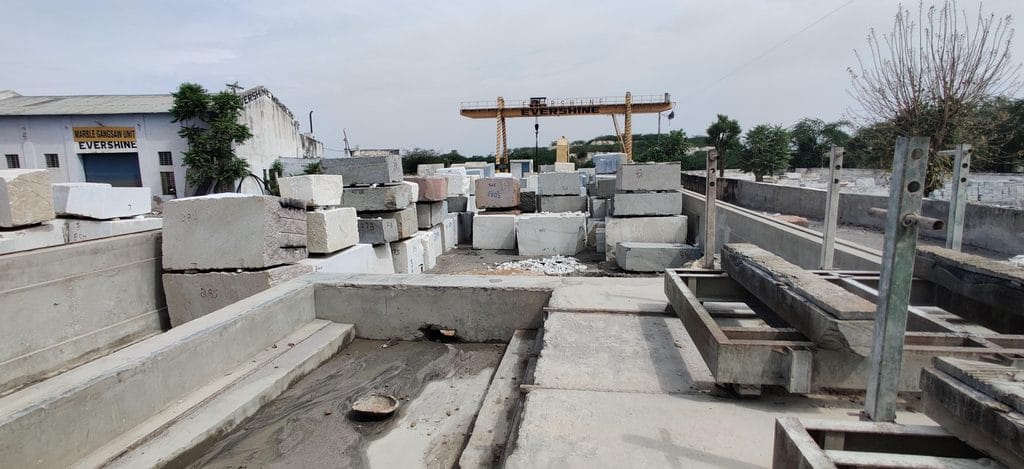
2. Block Cutting – Where One Block Becomes Many Slabs
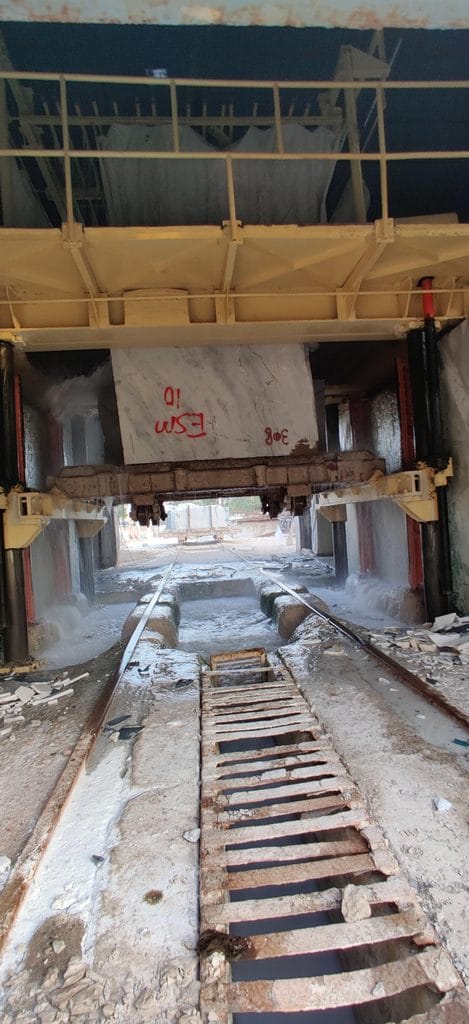
Once the block reaches the processing factory, it is positioned inside a cutting machine.
Large blocks are generally cut using modern block-cutting systems such as gang saws or other suitable cutting machinery, depending on the material and required production.
The block is cut into multiple slabs of a predetermined thickness.
For example, depending on the marble and application, slabs may be processed in thicknesses such as:
- 15 mm
- 16 mm
- 17 mm
- 18 mm
- 20 mm
- 30 mm and more for specialised applications
The exact thickness can vary according to the material, project requirements and processing method.
This stage is extremely important because the internal structure of the block is revealed only after cutting.
A block that looked excellent from the outside may reveal:
- More veins than expected
- Cracks
- Colour changes
- Patches
- Open areas
- Fossils
- Mineral marks
- Internal weakness
- Shade variation
Similarly, a block that looked ordinary from the outside can sometimes produce beautiful and consistent slabs.
This is why experienced marble buyers and processors do not judge a block only from one external surface.

3. Slab Processing – Cutting Is Only the Beginning
After the block has been cut, the raw slabs are not immediately ready for a luxury flooring project or countertop.
They go through several processing stages.
Depending on the material, the factory may carry out:
Resin/Epoxy Treatment → Grinding → Polishing → Calibration → Edge/Surface Finishing → Final Inspection
Each step has a purpose.
Resin and Epoxy Treatment
Some marble contains natural cracks, open veins, cavities or small holes.
Depending on the material, resin or epoxy may be used to fill and strengthen certain imperfections.
This process can improve the appearance and usability of the slab.
However, buyers should understand that resin treatment does not mean every slab becomes identical to a naturally flawless slab.
The underlying characteristics of the stone still matter.
Grinding
Grinding removes surface irregularities and prepares the stone for polishing.
Several abrasive stages may be used depending on the factory and the material.
Polishing
Polishing brings out the colour, depth and natural pattern of the marble.
A high-quality marble can develop a beautiful reflective surface after proper processing.
But the final polish is influenced by the stone itself.
Some materials catch a very high polish, while others have a comparatively different finish.
This is another factor that can influence price.
Why Are Two Lots of the Same Marble Priced Differently?
This is one of the biggest questions customers ask:
“If both are the same marble, why is one lot ₹300 per sq. ft. and another ₹500, ₹800 or even more?”
The answer is simple:
The marble name tells you what the stone is. It does not tell you the exact quality of the particular lot.
Natural marble is graded according to the characteristics of the material that has actually been produced.
Two lots can have differences in:
- Background colour
- Colour consistency
- Vein pattern
- Vein density
- Crack percentage
- Open veins
- Pinholes
- Patches
- Grain structure
- Polish quality
- Resin requirement
- Thickness
- Slab size
- Usable area
- Wastage
- Bookmatch potential
- Overall visual appeal
- Availability and demand
Therefore, price per square foot should never be the only method used to judge marble quality.
Understanding Marble Lot Quality
A lot generally refers to a particular group of slabs that share a common source or processing batch and have similar characteristics.
For example, a marble supplier may have:
Lot A: Cleaner white background with minimal variation
Lot B: White background with more grey veins
Lot C: More visible patches and variation
Lot D: Stronger veins and more dramatic patterns
All four may be sold under the same marble name.
But their commercial value may be different because the visual characteristics and usable quality are different.
This is especially important for architects, builders, interior designers and homeowners selecting marble for a large project.
Imagine you need 10,000 square feet of marble.
If you purchase a very mixed lot, you may receive slabs with substantial variation between one area and another.
If you purchase a well-selected consistent lot, the overall project may have a much more uniform appearance.
That consistency itself has commercial value.
The Biggest Factors That Determine Marble Price
1. Background Colour
For many marble varieties, the background colour is one of the first things buyers notice.
In white marble, for example, customers may compare:
- Bright white
- Milky white
- Creamy white
- Off-white
- Grey-white
- White with subtle movement
A cleaner and more desirable background may command a higher price depending on the particular marble and market demand.
However, whether a particular shade is “better” depends on the intended application.
For a modern minimalist interior, a cleaner background may be preferred.
For a luxury feature wall, stronger natural movement may be desirable.
2. Veins and Natural Pattern
Veins are one of the most important characteristics of natural marble.
Some marble has:
- Fine veins
- Large veins
- Straight veins
- Cloud-like patterns
- Random movement
- Cross veins
- Dramatic veins
- Grey veins
- Golden veins
- Greenish veins
- Brown or reddish veins
The presence of veins does not automatically mean the marble is lower quality.
In some premium marble varieties, the veins are actually one of the main reasons the material is expensive.
The question is not simply:
“Does the marble have veins?”
The better question is:
“What type of veins does this particular lot have, and how suitable are they for the intended design?”
3. Cracks and Open Veins
Natural marble can contain structural characteristics such as cracks and open veins.
A small amount of natural variation can be normal.
However, excessive cracking may affect:
- Usable area
- Processing
- Installation
- Wastage
- Long-term suitability for certain applications
This is why a buyer should inspect the actual slabs rather than relying only on photographs.
4. Pinholes and Natural Cavities
Certain natural stones can contain small cavities or pinholes.
Depending on the marble variety, these may be filled during processing.
The number, size and visibility of these areas can influence the final appearance.
When comparing two lots, it is therefore useful to inspect the slabs under proper lighting rather than looking only at a small sample.
5. Polish Quality
A marble slab can look dramatically different before and after polishing.
A good processing line can reveal the depth and character of the stone.
The quality of polishing may influence:
- Reflection
- Colour depth
- Surface appearance
- Vein clarity
- Overall presentation
A customer comparing two lots should ideally inspect finished polished slabs rather than judging only raw material.
6. Shade Consistency
Suppose a customer is buying marble for an entire house.
If the project requires a uniform appearance, shade consistency becomes very important.
A lot with significant variation may still be beautiful, but it may not be suitable for a project where uniformity is the priority.
For large projects, buyers should ask:
“Are these slabs from the same lot?”
This simple question can prevent many problems later.
7. Slab Size and Usable Area
Two slabs may have the same nominal dimensions but different usable areas.
For example, one slab may have:
- Better rectangular shape
- Fewer defective areas
- More usable surface
- Better edge condition
Another slab may require more cutting around natural imperfections.
Therefore, the real value should sometimes be considered in terms of usable square feet, not simply total square feet.
Why a Cheap Lot Is Not Always the Most Economical Lot
Suppose Lot A costs ₹300 per sq. ft.
Lot B costs ₹400 per sq. ft.
At first glance, Lot A appears cheaper.
But imagine Lot A has more variation and requires significantly more wastage during cutting and installation.
Lot B may have better consistency and higher usable area.
For a large project, the final project cost may therefore be influenced by more than the purchase price.
This is why professional marble buying involves looking at the complete value of the lot, not just the headline price.
How to Compare Two Marble Lots Before Buying
When comparing two lots of the same marble, use a systematic approach.
Step 1 – Compare the Background
Place slabs from both lots next to each other.
Look at:
- Base colour
- Brightness
- Uniformity
- Warm or cool tone
- Overall cleanliness
Step 2 – Compare the Pattern
Check whether the veins and natural movement are:
- Fine
- Heavy
- Random
- Continuous
- Broken
- Dramatic
- Subtle
Step 3 – Check the Slab Under Proper Light
Natural stone can look different under showroom lighting, sunlight and artificial lighting.
Inspect it under good, even illumination.
Step 4 – Look for Cracks and Open Areas
Do not inspect only the centre.
Look carefully at:
- Corners
- Edges
- Vein intersections
- Natural cavities
- Filled areas
- Long lines
Step 5 – Check the Back and Front
Where possible, inspect both sides and understand the processing history.
Step 6 – Check Whether the Slabs Belong to One Lot
For a large project, lot consistency can be more important than buying a random mixture of individually attractive slabs.
Step 7 – Consider Your Application
The “better” lot depends on where you are going to use it.
For example:
Flooring: consistency, durability and usable area may be important.
Feature wall: dramatic veins may be desirable.
Bookmatching: pattern continuity and vein direction become extremely important.
Temple/carving: block quality, thickness and internal structure can be more important than surface appearance alone.
Luxury residential flooring: background colour, polish, consistency and overall visual character may receive greater attention.
What Makes One Lot Better Than Another?
There is no universal rule that says one characteristic automatically makes every marble lot better.
A lot is more suitable when its characteristics match the customer’s requirement.
For example:
For a Plain White Marble Floor
A buyer may prioritize:
- Cleaner background
- Consistent shade
- Minimal unwanted patches
- Good polish
- Low variation
For a Feature Wall
A buyer may prefer:
- Strong veins
- Dramatic movement
- Attractive pattern
- Better slab dimensions
- Matching pieces
For Bookmatch Work
The buyer should focus on:
- Vein continuity
- Slab sequence
- Block direction
- Mirror-like pattern
- Slab thickness
- Matching pair availability
For Large Commercial Projects
The buyer may focus heavily on:
- Lot consistency
- Quantity availability
- Thickness consistency
- Processing quality
- Delivery schedule
- Wastage
- Long-term supply availability
Therefore, rather than asking only:
“Which lot is better?”
Ask:
“Which lot is better for my project?”
That is the more useful question when purchasing natural stone.
How Marble Factories Sort and Grade Finished Slabs
Once slabs are polished, they are inspected and sorted.
The exact grading system can vary between suppliers and marble varieties.
The inspection may consider:
- Colour
- Pattern
- Veining
- Surface quality
- Cracks
- Open areas
- Pinholes
- Polish
- Thickness
- Dimensions
- Resin/epoxy treatment
- Overall visual appeal
- Usable area
Slabs with similar characteristics may be grouped together.
This creates different commercial categories and price points.
That is why you may see the same marble available at several different prices.
The difference is not necessarily because the seller is randomly changing the price.
Often, the material itself is different in quality, appearance, consistency or usability.
Why Factory Processing Can Also Change the Value of Marble
Processing is not just about making marble shiny.
Good processing can improve the presentation and usability of natural stone.
A factory must carefully manage:
- Block cutting
- Slab thickness
- Resin treatment
- Grinding
- Polishing
- Calibration
- Handling
- Inspection
- Packing
Poor handling can damage slabs.
Incorrect processing can affect surface quality.
Inconsistent thickness can create problems during installation.
Therefore, the processing facility and its quality-control practices are also important parts of the marble supply chain.
Why Buying From a Marble Manufacturer or Established Supplier Can Matter
When buying natural stone for a large project, customers often benefit from dealing with a supplier who understands the material from block to finished slab.
At Evershine Marbles, our focus is not simply on showing a customer a marble sample and quoting a price.
We deal with natural stone and understand the importance of:
Block selection → Processing → Lot consistency → Quality inspection → Customer requirement
This is particularly important when a customer is looking for Makrana marble, white marble, Indian marble, imported marble, granite and other natural stones.
For a large project, the right material is not necessarily the material with the lowest quoted price.
The right material is the one that provides the required combination of appearance, quality, consistency, usability and value.
A Simple Example: Why Three Lots Can Have Three Prices
Imagine that three lots are available under the same marble name.
| Factor | Lot A | Lot B | Lot C |
|---|---|---|---|
| Background | Clean | Moderate variation | More variation |
| Veins | Subtle | Medium | Heavy |
| Cracks/Open Areas | Low | Moderate | Higher |
| Shade Consistency | High | Medium | Low |
| Polish | Good | Good | Average |
| Usable Area | High | Medium | Lower |
| Project Suitability | Uniform flooring | Mixed applications | Feature applications |
| Price | Higher | Medium | Lower |
This does not mean Lot A is automatically the “best marble” for every project.
If someone wants a dramatic feature wall, Lot C may actually offer the visual character they are looking for.
The important point is that price differences often reflect differences in the characteristics of the material.
Questions Every Marble Buyer Should Ask Before Finalizing a Lot
Before purchasing marble, especially for a large project, ask your supplier:
- Is this material from one lot or mixed lots?
- Can I inspect the actual slabs?
- What is the approximate usable area?
- What is the thickness?
- Has the material been resin treated?
- Are there visible cracks or open veins?
- How consistent is the shade?
- Can additional material from the same lot be supplied later?
- Is the price based on total slab area or usable area?
- Can the slabs be arranged according to the project’s design?
- Is the material suitable for my intended application?
- Can I see multiple slabs together rather than just one sample?
These questions can make the buying process much clearer.
Why You Should Never Judge Marble Only From One Slab
One of the most common mistakes is selecting a marble after seeing one beautiful slab.
One slab can look excellent while another slab from the same block or lot may have a different pattern.
This is particularly important with highly veined natural stones.
If the project is large, always try to inspect a larger selection of slabs.
Look at them together.
Check the sequence.
Understand the shade variation.
For premium projects, slab layout and selection can be almost as important as the initial purchase decision.
The Difference Between Natural Variation and Defect
This is another important concept.
Not every mark in marble is a defect.
Natural stone can contain:
- Veins
- Mineral deposits
- Colour movement
- Fossils
- Grain
- Natural patterns
- Small variations
These are part of the character of natural stone.
At the same time, cracks, excessive open areas or processing-related problems may require closer evaluation.
The buyer should therefore understand the difference between natural character and material/processing issues.
An experienced marble supplier can help explain these differences before purchase.
From Quarry to Your Home – The Complete Journey
A marble slab may travel through a surprisingly long journey before reaching the final customer:
1. Natural deposit is identified
↓
2. Marble block is extracted
↓
3. Block is inspected
↓
4. Block is transported to the processing facility
↓
5. Block is cut into slabs
↓
6. Raw slabs are inspected
↓
7. Resin/epoxy treatment is carried out where required
↓
8. Slabs are ground
↓
9. Slabs are polished
↓
10. Slabs are calibrated and finished
↓
11. Quality inspection takes place
↓
12. Slabs are sorted into lots/categories
↓
13. Price is determined according to material characteristics and market factors
↓
14. Slabs are packed and dispatched
↓
15. Final cutting and installation takes place at the project
Understanding this journey makes it much easier to understand why marble pricing is not simply based on the name printed on the slab.
How Evershine Marbles Helps Customers Select the Right Marble
At Evershine Marbles, we believe that marble buying should be based on understanding the material rather than simply comparing one price with another.
Our team deals with different categories of natural stone, including Makrana Marble, Indian Marble, White Marble, Imported Marble, Granite and other premium natural stones.
We help customers understand the differences between lots, shades, patterns and qualities so they can select material according to their project requirements.
Whether the requirement is for:
- Residential flooring
- Luxury homes
- Hotel projects
- Commercial buildings
- Feature walls
- Staircases
- Temple projects
- Carving
- Elevation
- Countertops
- Large architectural projects
the selection process should begin with understanding the application.
The right marble is not simply the cheapest marble or the most expensive marble. It is the material that matches the project’s design, quality requirements, quantity and budget.
Final Thoughts: Marble Pricing Is About More Than Just a Name
The next time you visit a marble factory or showroom and see two pieces of the same marble at different prices, remember that the marble name is only the beginning of the story.
The actual price can be influenced by:
Block quality + background colour + natural pattern + veins + cracks + processing + polish + consistency + usable area + slab size + lot quality + availability + market demand
This is why experienced marble buyers look beyond the price per square foot.
They inspect the actual lot.
They compare slabs together.
They understand the application.
And they consider the complete value of the material.
Natural marble is unique precisely because it is natural. No two blocks are guaranteed to be exactly identical, and no two lots should automatically be expected to have the same appearance or commercial value.
So, when selecting marble, don’t ask only:
“What is the price per square foot?”
Also ask:
“What quality am I getting for that price?”
“What is the consistency of the lot?”
“How much usable material will I receive?”
“Is this lot suitable for my project?”
These questions can help you make a much more informed marble purchase.
Looking for the Right Marble Lot?
If you are searching for Makrana Marble, Makrana White Marble, Indian White Marble, Imported Marble, Premium White Marble, Granite or other natural stones, talk to Evershine Marbles.
Our team can help you understand different marble qualities, compare available lots and select material according to your project’s design, quantity and application.
Visit Evershine Marbles and explore our range of natural stones.
Contact Evershine Marbles today to discuss your marble requirement, inspect available lots and find the right material for your project.